
KYOCERA Document Solutions


Give away control, but not too much. That is the pragmatic approach many European organisations are taking when it comes to IT modernisation.
This is one of the main findings from Quocirca’s independent market research; hybrid cloud adoption is prevailing in print because buyers want lower infrastructure spend and easier scalability, not wholesale disruption.
At the same time, data-centre electricity demand is projected to keep climbing this decade by the IEA, reinforcing the value of consolidating many inefficient in-house servers into professionally managed platforms.
The result of this equation points towards one solution: cloud printing software and cloud solutions are how organisations shrink their footprint, stabilise costs, and stay secure in the cloud without adding IT overhead.
Let’s walk through different solutions to modernise your IT stack.
The weight of working without cloud solutions
Traditional print stacks look small on paper but sprawl out of control in practice. Each office location typically runs its own print server, creating a distributed network of hardware that demands constant attention. The visible costs are straightforward:
- Server purchases
- OS licences
- Backup systems
Deeper operational drains
Every site adds another physical server consuming power around the clock, requiring cooling infrastructure, and occupying valuable floor space. IT teams spend hours troubleshooting print queues, resolving VPN issues for remote users, testing driver compatibility across different operating systems, and scheduling patch windows that disrupt operations. When hardware fails, document workflows grind to a halt until replacement parts arrive and technicians complete repairs.
The distributed model also fragments visibility. Finance cannot easily track total print costs across locations, making budget planning reactive rather than strategic. Meanwhile, outdated drivers and inconsistent policies across sites create security gaps and compliance headaches.
Risks of decentralised print management
Maintaining on-premises print infrastructure carries three compounding risks that intensify as organisations scale:
Operational fragility: Multiple print servers mean multiple points of failure. When a server goes down, every user at that location loses print capability until IT can respond. Remote workers dependent on VPN connections face additional friction, often resorting to workarounds that bypass security controls.
Escalating costs: Server refreshes and storage expansions punch holes in annual budgets. Each site requires its own hardware, licences, and maintenance contracts. Energy consumption compounds as cooling systems work overtime to manage server heat. E-waste accumulates as ageing equipment reaches end-of-life faster than refresh cycles can accommodate.
Security and compliance exposure: Distributed print servers create inconsistent policy enforcement. Some sites may require authentication while others allow open access. Patch management becomes irregular as IT prioritises critical systems, leaving print servers vulnerable. Audit trails fragment across locations, making compliance reporting labour-intensive and error prone.
These risks persist because organisations perceive migration as disruptive. However, cloud solutions address these concerns while delivering immediate operational improvements.
What is Kyocera Cloud Print and Scan?
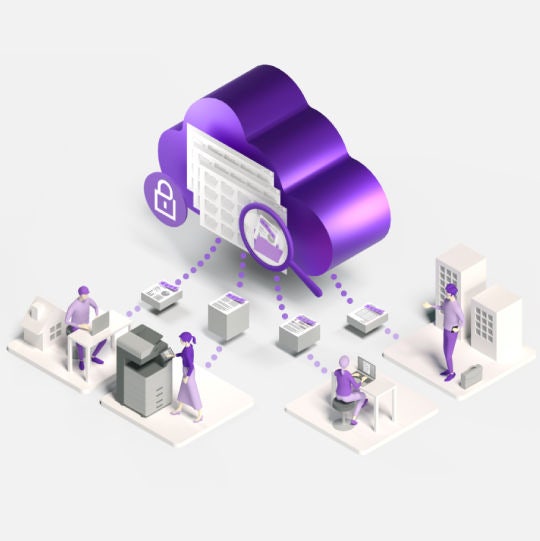
It’s the comprehensive way to stay on top of printing costs, keep information safe, reduce costs and connect teams.
Moving to a cloud solutions deliver immediate operational improvements.”
Cloud Solutions: deliver secure, scalable print
At Kyocera Document Solutions, we see organisations achieving the strongest results when they consolidate fragmented print and content infrastructure into governed cloud platforms. This approach eliminates on-premises servers while maintaining the control that European buyers demand.
Centralised print management: secure and scalable
Eliminate infrastructure overhead with cloud printing: Kyocera Cloud Print and Scan (KCPS) removes physical print servers entirely and manages queues, drivers, and rules centrally across every site. There is no hardware to purchase or maintain, and capacity scales automatically as headcount or locations change. Secure release ensures documents only print when users authenticate at the device, preventing abandoned jobs and unauthorised access.
Govern content without local file servers: For teams that need shared workspaces, Kyocera Cloud Information Manager (KCIM) provides a cloud-based document management platform with secure browser access from anywhere. KCIM centralizes all your physical and digital documents, with intelligent indexing for easy location, document history tracking for full visibility, and role-based access permissions to ensure secure collaboration across the enterprise.
Capture paper documents securely at entry: Kyocera Cloud Capture (KCC) handles the paper-to-digital transition through authenticated scan-to-cloud workflows. Documents digitised at the MFP are automatically processed with OCR, converted to searchable formats, and routed directly to KCIM or third-party cloud storage. This eliminates the insecure practice of scanning to local PCs before upload.
Embed security without complexity: The serverless model means updates and security fixes arrive automatically with the service while keeping operations running without after-hours maintenance windows. Additionally, it allows you to enforce Single Sign-On (SSO) and Multi-Factor Authentication (MFA) across print, capture, and content management. Finally, apply least-privilege roles to ensure users access only what they need. This translates into identity-first controls and continuous updates to maintain a strong security posture while reducing IT workload.
Benefits of Cloud Document Management and Cloud Printing
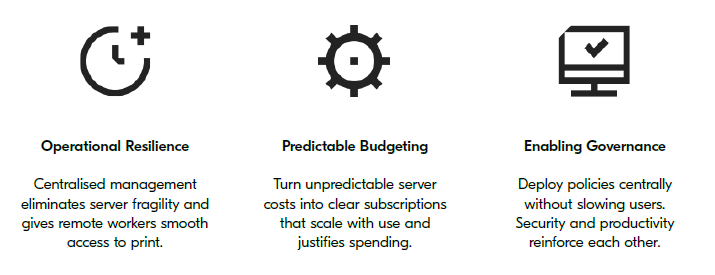
Moving print and content services to cloud solutions delivers value across operational, financial, and strategic dimensions:
Want practical help mapping risks and closing gaps?
Our experts can help you pilot cloud printing and cloud document management with data protection by design, robust audit trails and secure document storage that works for your people.

- The critical need for printer security
- How cloud printing benefits hybrid workers
- Collaborate across teams with cloud capture
FAQ
Learn more about us
- FAQ
Yes. KCPS is designed to “remove the costs of on-site servers” while centralising control and usage policies. You cut hardware, maintenance, and energy at once.
KCPS supports secure print release (user authentication at the device) and runs as a managed platform; combined with KCIM’s encrypted storage and credential checks, this strengthens cloud network security end-to-end.
Use KCC to authenticate at the MFP and route scans directly to governed cloud destinations, cutting risky detours via desktops or email.
Shifting to service reduces capex spikes and gives predictable monthly costs for cloud solutions, while reporting helps align spend with use. KCPS/KCC/KCIM bring the controls and visibility finance needs.