
KYOCERA Document Solutions


The European healthcare sector has ambitious sustainability goals. At Kyocera, we aim to support these goals with technology designed around our ESG principles.
This article looks at what that means in practice, from the long-life components that have defined ECOSYS technology to the energy efficiency and reporting tools that make a measurable reduction in your company’s footprint. It also examines the design choices that make our devices easier for a diverse healthcare workforce to use.
Let’s explore the facts.
Engineering for a Long Life in a Clinical Setting
At Kyocera, we’ve invested in design-led durability to reduce costs and protect the environment since 1992, with the inception of our first ECOSYS printer: the FS-1500. It was built around a long-life amorphous silicon drum capable of printing 300,000 pages with only toner needing replacement. This ran against the industry norm of parts designed to wear out.
That approach was recognised externally in 1997, when a later ECOSYS model became the first printer in the world to be awarded Germany's Blue Angel eco-label, a mark reserved for products that meet strict environmental criteria across their working life. The label mattered because it came from outside the company. And this was at a time before healthcare procurement scored device lifespan alongside price.
The same principle still guides hardware development today. From the recycled materials used in device components to the end-of-life recycling built into every design brief, Kyocera remains a consistent choice in a sector where reliability is essential.
Measuring a Product’s Impact Across Its Life
Long-life components only get you so far if the rest of a product’s footprint goes unmeasured. We apply a Life Cycle Assessment methodology to reduce a product’s environmental impact across its entire life. This matters now that healthcare procurement weighs environmental performance alongside price and function. Many of our devices also carry the Blue Angel ecolabel, which covers criteria including recyclable design.

We screen every part and material for restricted chemical substances at all our plants and audit suppliers before we work with them. We also assess water risk across our production sites. At our China plant, recycling wastewater from the cleaning process cuts water intake by 55,200 m³ a year.
None of this happens in isolation. We’re one of 96 companies in the Kyocera Document Solutions group, part of a global network that runs from R&D through to customer support.
Built for Energy Efficient Printing
Our innovation goes beyond considering how long a printer lasts. We also look at how much energy it uses throughout its life. ECOSYS technology combines long-life components with low energy consumption. Its low-temperature toner needs less heat to fuse to the page, while features such as sleep mode help reduce energy use when the device is not in active use. This contributes to ENERGY STAR® certification and lower energy consumption overall.
For a ward or clinic running devices continuously across long shifts, those savings accumulate in ways a single spec sheet cannot show. Print management tools track that activity as it happens, giving your estate a true picture of how paper, power and consumables are being used.
And you’ll appreciate this visibility for decision-making in procurement. Measured energy use can help inform replacement and consolidation decisions, while providing the evidence increasingly required in healthcare tenders.
Designing Out Waste After the Sale
Our toner and hardware recycling scheme helps contribute to a circular economy. You can return used consumables and end-of-life hardware through the scheme rather than sending them to general waste.
Software plays a role here too. In clinical document management, Kyocera Capture Manager and Kyocera Cloud Capture convert paper documents into searchable digital files at the point of scanning, reducing the volume of paper that needs to be printed, stored and eventually disposed of.
Research investment keeps this cycle moving. Work carried out through our global headquarters R&D centre in Osaka and other research sites has contributed to Kyocera being named among Clarivate’s Top 100 Global Innovators on 10 separate occasions.
Turning Usage Into Evidence
Managed print services and device management software track device activity, print volumes, energy use and consumables continuously, and that data converts into carbon metrics across relevant Scope 2 and Scope 3 emissions. Dashboards then break usage down by device, department or location, giving your sustainability team a working view rather than a once-a-year snapshot.
The same data can also help you take action. Managed print services can identify underused equipment and help you optimise your printer fleet around actual demand. They can also automate energy-saving settings and encourage paper-efficient habits, such as duplex printing and secure print release.
For a healthcare organisation working towards ESG targets, that combination gives you a defensible footprint alongside the numbers to prove it. Both matter equally when a board or a regulator asks the same question your own procurement team already has.
Designed Around the People Who Use It
It’s important to remember that sustainability is only one part of ESG. The social side matters too, including how easy and accessible technology is for the people using it every day.
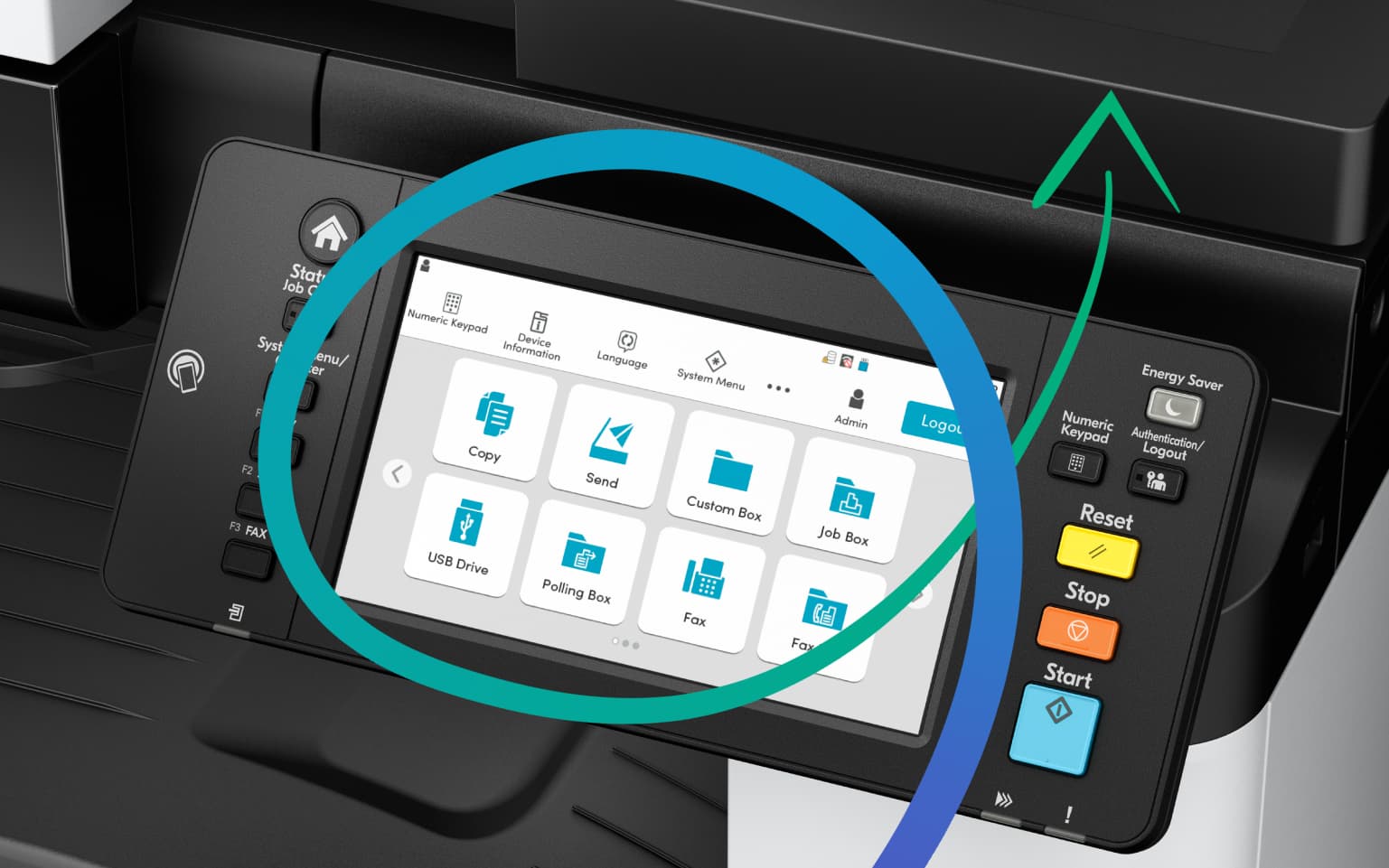
A device that is difficult to use can add unnecessary pressure to busy healthcare teams, particularly when staff are joining from different countries and backgrounds. Kyocera designs its multifunction printers with this in mind, using tiltable operation panels, high-contrast displays and a tablet-like touch interface that is easy to understand. Embossed key markings and low-force paper drawers also make everyday tasks easier for a wider range of users.
Language is another part of this. Standard MFPs support between 10 and 23 languages, allowing staff to use the device in a language they are comfortable with. For diverse healthcare teams, that can remove a simple but recurring source of confusion.
Inclusive design also has practical environmental benefits. When people can use a device correctly from the start, there is less need for support. That means fewer reprints and fewer trips to the wastepaper bin.
How Designing for Longevity Helps You
In short, designing for longevity means considering the entire lifecycle of a device, from how it is built to how it performs in everyday use. For healthcare organisations, this can mean fewer service visits, longer intervals between parts replacement, lower energy use and clearer information for procurement teams.
This approach has shaped Kyocera’s product design for more than three decades. By combining long-life components, efficient operation and measurable environmental performance, we build technology to last to support your organisation’s goals.
Read More ESG Articles
Access more articles about how Kyocera supports ESG in European healthcare.



- Why Kyocera Cares
- Future-Fit Business
- Enabling Sustainable Business
Commonly Asked Questions
How product design works in practice, and what it means for a healthcare estate.
- FAQ
A long-life amorphous silicon drum means routine servicing replaces toner only, rather than a whole cartridge and drum each time.
It measures a product’s impact from raw materials to disposal, and Kyocera applies it during design, while material choices can still change.
Print management tools record device activity, print volumes and power use continuously, converting it into Scope 2 and Scope 3 figures.
Clear interfaces and multilingual panels reduce user error, which means fewer reprints, less wasted paper and fewer support visits.
Want the evidence behind the design?
Talk to Kyocera about lifespan, energy and recycling data for the devices your healthcare teams rely on.