
KYOCERA Document Solutions


What will the future of logistics operations look like?
From automation to new technologies, the coming years will reshape how organisations plan, move and manage goods.
At the same time, organisations face rising geopolitical volatility and growing cost pressure. These challenges demand a fundamental rethink of how logistics operations are run, with success depending on digitalisation and highly connected logistics technology ecosystems.
In this blog, we explore the logistics technology trends shaping operations and how Kyocera supports organisations preparing for a more resilient and sustainable future.
The logistics trends shaping the future of operations
Across the trends below, one theme keeps coming up: logistics operations are becoming more data-driven, more connected and far less manual.
Below are the logistics technology trends that are already changing how organisations manage and execute their operations.
Trend 1: Artificial intelligence becomes a logistics co-pilot
AI is moving from experimentation to everyday decision-making within logistics operations.
It’s increasingly used to reroute shipments when disruptions such as traffic, weather or port congestion occur, helping deliveries continue with minimal manual intervention. It also supports inventory planning by analysing sales trends and customer behaviour to ensure the right stock is available at the right time.
AI is also being used to automatically send order updates to suppliers, confirm delivery times and check stock availability.
For logistics operations, the real shift is towards autonomous decision-making supported by AI that can act on live data rather than relying solely on human intervention.
Trend 2: Automation expands across warehouses and fulfilment centres
Automation continues to grow as volumes increase and delivery windows shrink.
In warehouses, advanced picking technologies streamline operations by handling inventory movement and accelerating order fulfilment. Self-driving trucks and delivery drones help bypass traffic congestion and infrastructure constraints.
These autonomous solutions are projected to significantly reduce delivery costs and are particularly valuable for serving remote and hard-to-reach locations.
This shift is also changing how people work, with logistics teams needing professionals with new skills to supervise automated systems and work alongside robotics and autonomous technologies.
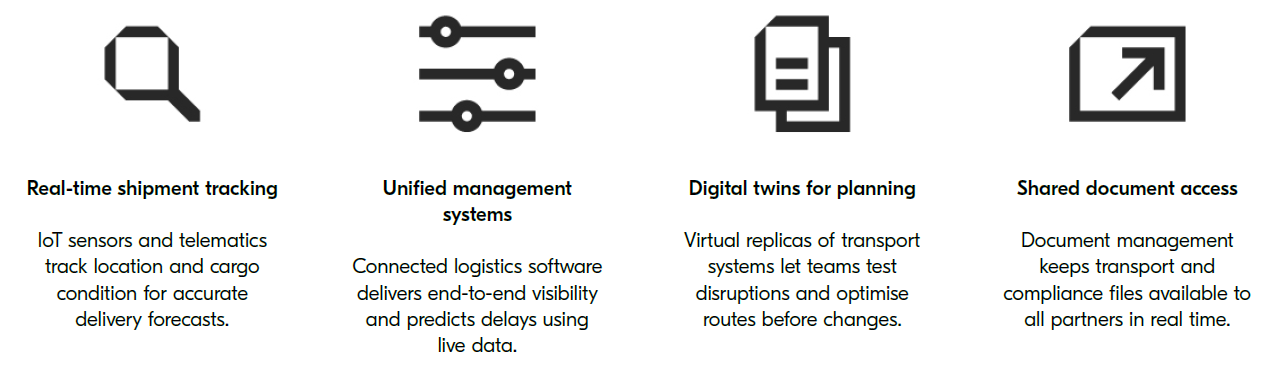
Trend 3: End-to-end digitalisation across transport and logistics
Digitalisation is becoming integral across transportation and logistics operations.
Trend 4: Sustainability becomes embedded into logistics technology
According to research from the World Economic Forum, logistics activities account for up to 11% of global greenhouse gas emissions.
As a result, sustainability is no longer a side initiative for logistics operations; it’s becoming a core operational priority.
Smart logistics platforms and TMS help combine orders into one trip, maximise vehicle utilisation and select more sustainable transport options, reducing unnecessary mileage and fuel use.
New dashboards enable carbon emissions to be tracked per shipment or route, allowing organisations to adjust logistics operations without slowing them down. Reusable packaging loops are also expanding, supported by tracking systems that manage return and redistribution cycles.
10 Reasons Why Logistics Teams Choose Kyocera
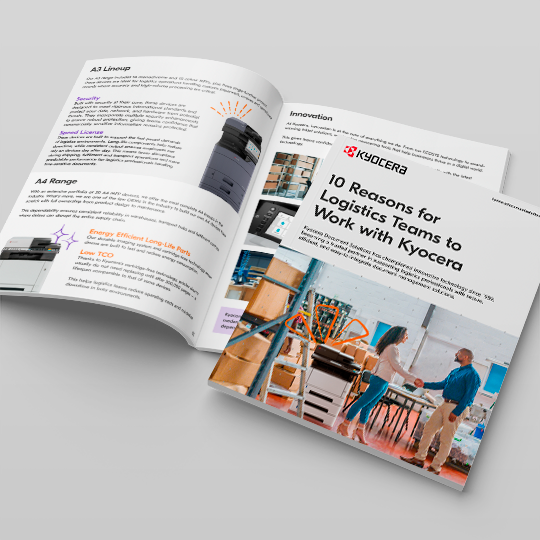
Our brochure explores the key reasons logistics organisations choose Kyocera, from secure logistics software and connected document workflows to reliable printing hardware designed for demanding operational environments.
How Kyocera strengthens modern logistics operations
As logistics operations become more connected and data-driven, organisations need logistics technology that supports the secure flow of information.
Kyocera supports these efforts by bringing reliable printing hardware, logistics software integration and secure document management into one connected ecosystem.
Kyocera supports logistics operations by bringing reliable printing hardware, logistics software integration and secure document management into one connected ecosystem.”
Integrated logistics software and document management
With in-house innovation and acquisitions, Kyocera uses proprietary software that helps logistics operations capture, manage and share information securely. Solutions such as Kyocera Cloud Capture (KCC) and Kyocera Cloud Information Manager (KCIM) enable logistics teams to capture documents directly from multifunctional printers (MFPs) and manage them in a central, searchable cloud workspace.
Reliable printing hardware for demanding logistics environments
Kyocera’s portfolio of reliable printing hardware includes A3 and A4 MFPs as well as a production-grade inkjet printer. These secure, cloud-ready devices support the printing, scanning and digitisation of documents.
Built-in protection for logistics information and workflow
Kyocera embeds security into every layer of its software solutions, hardware and cloud-based management. Multi-layer safeguards protect sensitive logistics documents, support regulatory compliance and reduce risk exposure across shared environments.
Independently tested devices and secure device firmware empower logistics teams to operate with confidence in an era of growing cyber threats.
Devices designed with sustainability in mind
ECOSYS cartridge-free technology reduces waste by requiring only toner replacement, even after very high print volumes. Lower energy consumption and long-life components support lower total cost of ownership and reduced environmental impact.
Keeping logistics operations moving with Kyocera
The future of logistics operations will be shaped by AI, automation, end-to-end digitalisation and sustainability requirements.
Organisations that invest in connected logistics technology, integrated logistics software and secure document management will be better positioned to improve visibility and operate more sustainably.
With a connected system of software solutions and reliable printing hardware, Kyocera supports logistics operations as they adapt to a more complex and interconnected global environment.

- Why Kyocera is a trusted partner for logistics
- Digitising medical transport documents with KCPS
- Turn paper into data with cloud printing
Ready to take the next step?
Our team can help you review your logistics operations and identify the right logistics technology, document management and printing solutions for your environment.