
KYOCERA Document Solutions


Hybrid work is no longer a question of "if", but "how".
For many organisations, hybrid models are already in place in some form. The real conversation now centres on how to make them secure, conducive to productivity, and aligned with business goals.
The answer begins with a clear IT strategy.
By strengthening document solutions and using secure cloud technology, IT teams can build resilient systems that support hybrid work without increasing complexity.
Benefits of hybrid work
Despite the popularity of remote work, some managers still question its impact on performance and company culture. In reality, those concerns don’t always align with what employees prioritise.
According to research, hybrid work remains the most common arrangement (44%) among EU employees whose roles can be performed remotely.
The desire to work exclusively from home has also increased significantly, rising from 13% in 2020 to 24% in 2024.
For organisations, this has strategic implications. Flexible work models can influence talent attraction, retention and employee engagement across competitive markets.
Hybrid work also accelerates digital transformation. Investments in cloud technology and modern document solutions make distributed work not only possible, but efficient.
Well-designed hybrid environments deliver:
- Stronger digital adoption: Investments in collaborative platforms and cloud-based tools accelerate digital transformation.
- Cost efficiency: Optimised office space and smarter resource allocation reduce overhead.
- Sustainability progress: Fewer commutes contribute to lower emissions and closer alignment with ESG goals.
How to design a modern and successful IT strategy
Hybrid work introduces new demands on IT teams. For hybrid work to work, a resilient IT strategy typically focuses on:
1. Alignment with remote work models
Systems, hardware and software must support employees regardless of their location. Choosing IT solutions that integrate smoothly across office and remote environments streamlines workflows.
2. Reliable technical support
Technical issues are inevitable in distributed environments. IT teams need structured support frameworks to minimise disruption and maintain productivity.
3. Strong security practices
Protecting data and devices is a major hybrid challenge. A resilient approach includes:
- Data encryption.
- Multi-factor authentication.
- Network protection tools.
- Regular updates and patch management.
- Employee cybersecurity awareness.
- Controlled access management.
How Kyocera devices empower hybrid work
Reliable hardware remains a critical foundation of any hybrid IT strategy. Devices must perform consistently across office and remote environments while integrating smoothly into secure digital workflows.
Multifunction printers (MFPs) simplify setups by combining print, scan and copy capabilities in a single device.
When evaluating MFPs for hybrid environments, IT teams should consider:
- Printing needs: Volume, colour requirements and number of users.
- Total cost of ownership: Including consumables and maintenance over time.
- Environmental impact: Energy efficiency and waste reduction.
- Ease of integration: Compatibility with existing systems.
Kyocera’s ECOSYS series, for example, addresses all of these priorities. ECOSYS devices reduces consumable waste through long-life components, supporting both sustainability goals and predictable cost management.
Built-in security features such as encrypted data processing, secure boot and automatic data overwrite protect information across distributed environments.
By combining secure hardware with cloud-enabled IT solutions, Kyocera enables hybrid teams to work with greater efficiency, visibility and control."
How cloud printing boosts office productivity
Cloud printing is central to a modern hybrid IT strategy.
With cloud technology, employees can initiate print jobs remotely, removing the need to be physically present at a device. This improves continuity across office and remote environments while maintaining control. Secure print release ensures documents are only accessed by authorised users, helping protect sensitive information. At the same time, organisations can reduce reliance on on-premises print servers, lowering costs and limiting exposure to potential data breaches.
Strong cloud security practices include:
- Monitoring and limiting file access
- Keeping network security updated
- Enforcing strong passwords and encryption
- Educating employees on best practices
Kyocera’s cloud printing solutions
Kyocera supports hybrid IT teams with cloud-connected document solutions designed for security and operational control.
- Kyocera Cloud Information Manager (KCIM) provides structured, permission-based document storage in the cloud, enabling teams to access and manage information securely from any location. This strengthens collaboration while maintaining governance.
- Kyocera Cloud Print and Scan (KCPS) brings secure print and scan management into the cloud. With KCPS, documents are scanned directly to the cloud, and capital expenses of having a dedicated on-site print server are removed.
Together, these cloud technology platforms integrate seamlessly with Kyocera devices, helping organisations modernise document workflows without increasing risk. By combining secure hardware with cloud-enabled IT solutions, Kyocera enables hybrid teams to work with greater efficiency, visibility and control.
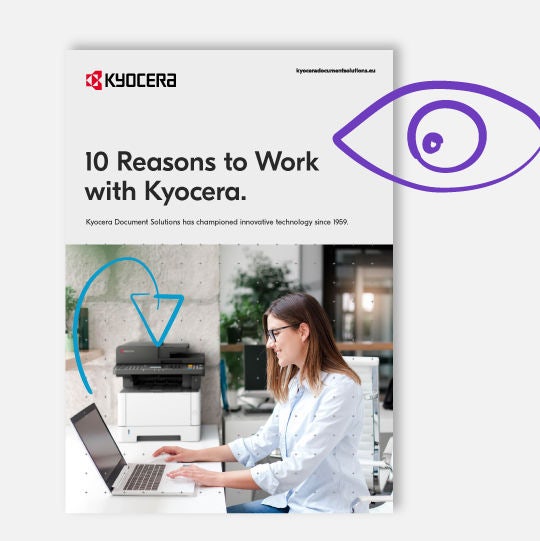
10 Reasons Why
From smarter document solutions and secure cloud technology to dependable hardware, explore the core advantages that make Kyocera a trusted partner for organisations shaping their digital future.
Future-ready IT begins with the right foundations
Hybrid working models continue to evolve, but the need for resilient IT systems remains. Organisations that align document solutions, cloud technology and device security within a clear IT strategy are better positioned to scale and protect their operations.
Kyocera supports teams with integrated IT solutions that connect secure hardware and cloud-powered workflows. When infrastructure is designed with resilience in mind, hybrid work becomes a strategic advantage rather than a technical challenge.


- Support smarter IT operations
- Prepare your IT infrastructure for growth
- Trends shaping modern IT
Do you have any questions for our experts?
Whether you're exploring new hardware, upgrading existing systems or simply looking for guidance, our team is here to help.