
KYOCERA Document Solutions


If the last few years taught us anything about sustainability, it is that simple narratives rarely survive contact with real-world workplaces.
Remote does not automatically mean greener; the impact depends on how you design the digital workplace. European policy now reflects this nuance. The European Green Deal and the Energy Efficiency Directive push organisations to cut energy use with smarter infrastructure decisions, while the EU Code of Conduct for Data Centres encourages transparency and efficiency.
Within this context, the question shifts from where people work to how they work: are your print, capture and content flows wasting energy, time and materials, or are they designed to do more with less?
Cloud document management turns small reductions into sustained Corporate and Social Responsibility (CSR).
At Kyocera Document Solutions, we see the biggest gains when IT and Operations replace scattered setups with governed cloud services. That does not mean sacrificing control: it means rightsizing capacity, reducing duplication and giving teams the proper tools for efficiency.
The hidden energy drains in your document infrastructure
Look under the desk or in the back room of many offices and you will still find servers quietly drawing power for print queues and local file storage. They are easy to ignore because they "still work," but they lock in costs and emissions that most organisations never measure.
Hybrid work impact
Hybrid work has exposed the cracks. Paper-dependent processes slow everything down:
- Contracts stalled waiting for signatures
- Scans trapped on isolated devices
- Print jobs abandoned in the wrong location
Each bottleneck adds unnecessary time, travel, and energy waste.
At the same time, fragmented storage creates:
- Duplicate files across shared drives
- Personal silos and unmanaged folders
- Endless email attachments
Together, these issues amplify confusion, slow decision-making, and increase your carbon footprint.
The infrastructure burden is real, but so is the governance gap. Without centralised visibility, IT teams struggle to enforce policies, track usage, or demonstrate CSR improvements. Local servers persist not because they are optimal, but because migration feels complex.
The risks of staying decentralised
Maintaining fragmented document management carries three compounding risks:
Environmental impact
Underutilised servers in multiple locations consume power around the clock, regardless of actual demand. Duplicate storage amplifies energy use while making files harder to find and manage.
Operational friction
Hybrid teams lose time navigating inconsistent systems. Documents get stuck in location-specific workflows, forcing unnecessary trips to the office or delays in approvals. Abandoned print jobs pile up, wasting paper and toner.
Compliance and security exposure
Decentralised systems make it harder to enforce data protection rules, maintain audit trails, or respond to GDPR requests. Sensitive documents left on printer trays or stored in unsecured folders create unnecessary risk.
The longer these inefficiencies persist, the harder it becomes to meet both sustainability targets and operational expectations. Cloud document management offers a pathway out, but only when implemented with structure and governance.
What is Kyocera Cloud Print and Scan?
A simple way to cut server energy, reduce waste, and keep hybrid teams moving: cloud print with secure release and central controls.
How Cloud Services enable resource optimisation
At Kyocera Document Solutions, we see the biggest gains when IT and Operations replace scattered setups with governed cloud services. That does not mean sacrificing control: it means right-sizing capacity, reducing duplication, and giving teams the proper tools for efficiency.
Solutions to solve bottlenecks
To reduce risks and optimise workflows, we created a list of solutions for you to implement easily:
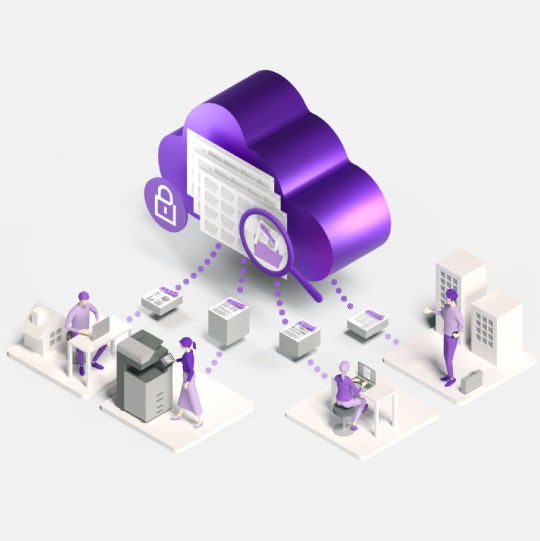
- Retire energy-hungry local servers: Moving print queues and file storage to managed cloud platforms eliminates the silent overhead of on-premises hardware. Kyocera Cloud Print & Scan (KCPS) centralises authentication, print rules, and queue management in a single cloud service. Meanwhile, Kyocera Cloud Information Manager (KCIM) provides a comprehensive cloud-based document management platform that brings all your physical and digital documents under control, centralising business data regardless of where staff are working, supporting up to 9 different document types. This enables a ready-to-deploy solution that accelerates digitisation and enhances productivity across the enterprise.
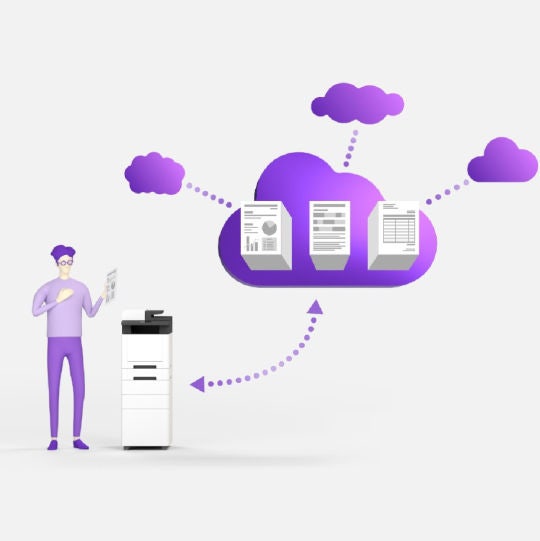
- Streamline hybrid workflows: Cloud capture and print release remove the friction that forces people back to the office. With Kyocera Cloud Print & Scan (KCPS), users authenticate at any authorised device and release prints securely on arrival—ending abandoned jobs. Kyocera Cloud Capture (KCC) lets teams tag and route scans directly at the MFP, so documents land in the right workspace first time.
- Embed efficiency through smart defaults: Cloud services work best when light-touch controls shape everyday habits. KCPS defaults to duplex and mono printing, with quotas and reporting to curb waste. KCIM automates document workflows and applies metadata-driven governance to reduce shadow storage and ensure compliance. KCC standardises capture presets to minimise rescans and errors. Together, these nudges turn small choices into sustained resource optimisation.
- Align with European standards: Choosing EU-aligned data centres and logging energy and utilisation stats provides the transparency needed to evidence CSR improvements. Consolidating sites behind a single policy set standardises updates, Multi-Factor Authentication (MFA), and Single Sign-On (SSO) – hardening security while reducing admin overhead.
Cloud document management turns small reductions into sustained CSR."
The compound benefits of centralised cloud document management
The shift to cloud services delivers value across three dimensions:
Operational resilience for hybrid teams: When documents are accessible from anywhere, work does not stall because someone is off-site. Teams work from one version with full traceability, eliminating confusion and oversharing. Secure print release via Kyocera Cloud Print & Scan ensures sensitive documents are not left on trays, closing the last mile in your document chain.
Measurable environmental gains: Replacing local infrastructure with precise, demand-driven capacity cuts baseline energy consumption. Fewer duplicate files mean less storage overhead. Reduced print waste and abandoned jobs lower paper and toner use. Quarterly reviews let you adapt rules to match usage patterns and communicate time savings to maintain momentum.
Governance without friction: Centralised cloud platforms extend your ECM/DMS beyond storage into end-to-end control: capture, store, collaborate, and output. KCIM serves as your centralised document management platform with intelligent indexing, role-based access control, multi-format support across 9 document types, and document history tracking to support secure digitisation and hybrid working environments. Together, these tools support European data protection needs while removing bottlenecks, proving that security and efficiency can reinforce each other.
Want practical help mapping risks and closing gaps?
Our experts can help you pilot cloud printing and cloud document management with data protection by design, robust audit trails and secure document storage that works for your people.
- Add value to your digitisation with KCIM
- KCC supports remote and hybrid workforces
- Why ECM is key for modern business success
FAQ
Learn more about us
- FAQ
It replaces always-on local storage with flexible capacity (on-premises, hybrid, or fully cloud-based), adds role-based access control and encryption through a sophisticated security framework, and reduces duplicate copies: less power usage, fewer boxes, stronger governance. KCIM is Kyocera’s Cloud DMS platform.
Yes. KCPS removes on-site print servers and enables secure release at any authorised device, avoiding wasted prints and unnecessary travel for paperwork. Policy controls (duplex, quotas) further cut materials.
KCC turns paper into digital content at the MFP through OCR and automated processing, indexing, file naming and routing directly to cloud storage or KEIM the first time. That reduces rescans, couriering documents, and inefficient storage: it turns small wins that add up in CSR reporting.
Favour providers aligned with EU transparency and efficiency expectations, then pair that with Kyocera’s governance layer (KCIM/KCPS/KCC) so your cloud services gains are auditable and secure.