
KYOCERA Document Solutions


When people think about sustainability, software and cloud platforms rarely come to mind.
Only recently have we started talking about the environmental cost of Artificial Intelligence (AI), for example. For many people, it came as a surprise to discover just how much energy these AI systems use.
The same applies to cloud technology and IT systems. Environmental, Social, and Governance (ESG) doesn't immediately seem connected to digital infrastructure.
Yet digital sustainability is becoming central to corporate ESG goals.
Well-designed IT systems can streamline operations, reduce resource use and support sustainability efforts across organisations.
In this blog, we explore how IT systems can play a strategic role in advancing ESG goals through digital transformation and smarter document solutions.
Role of IT in sustainability
Underused servers across multiple sites consume energy continuously, even when demand is low. Storing data in disconnected systems drives up energy use, increases avoidable printing, and reduces IT teams’ visibility over workflows.
Digital transformation helps tackle these issues. By replacing paper-heavy workflows with digital processes, organisations reduce reliance on physical storage, consumables and energy-intensive infrastructure. Cloud technology enables hybrid collaboration, which can reduce commuting and support broader digital sustainability objectives.
Business leaders are responding decisively. According to Deloitte’s 2024 CxO Sustainability Report:
- 85% of executives increased sustainability investments in the past year.
- 50% have already implemented sustainable IT solutions.
- 42% plan to do so within the next two years.
For many organisations, investing in cloud technology and modern document solutions is now part of their ESG strategy.
Cloud document management for a lower carbon footprint
One of the clearest ways IT professionals can advance ESG goals is by modernising document infrastructure.
At Kyocera, we see the strongest results when organisations replace scattered systems with governed cloud services.
Digitisation isn't about eliminating paper entirely, however. It's about reducing unnecessary paper usage. By transitioning to digital workflows, organisations conserve paper and toner, reduce transport and storage needs, and lower the energy consumption associated with print-heavy environments.
At Kyocera, we see the strongest results when organisations replace scattered systems with governed cloud services."
How Kyocera's Cloud Suite supports ESG goals
Kyocera’s Cloud Suite enables organisations to digitise physical documents and manage information through secure, cloud-based platforms. By converting paper into structured digital content and routing it directly to central repositories, businesses simplify storage, retrieval and collaboration across teams.
- Kyocera Cloud Print and Scan (KCPS) centralises authentication, print rules and queue management in a single cloud service, removing the hidden overhead of local print servers. Secure print release ensures jobs are only produced when users authenticate at the device, preventing abandoned prints and reducing waste.
- Kyocera Cloud Information Manager (KCIM) provides a cloud-based document management platform that centralises information, bringing physical and digital documents under structured control. By consolidating data across locations and supporting multiple document types, KCIM accelerates digitisation while improving visibility and compliance. It also allows employees, with access, to retrieve documents from the cloud from any location.
- Kyocera Cloud Capture (KCC) enables users to scan, tag and route documents directly from a multifunctional printer (MFP) to approved cloud destinations, reducing manual handling and minimising errors at the point of capture.
These digital cloud solutions reduce unnecessary printing, limit reliance on on-premises infrastructure and support more efficient document management. The result is a lower environmental impact across day-to-day operations, alongside stronger visibility and control over company data.
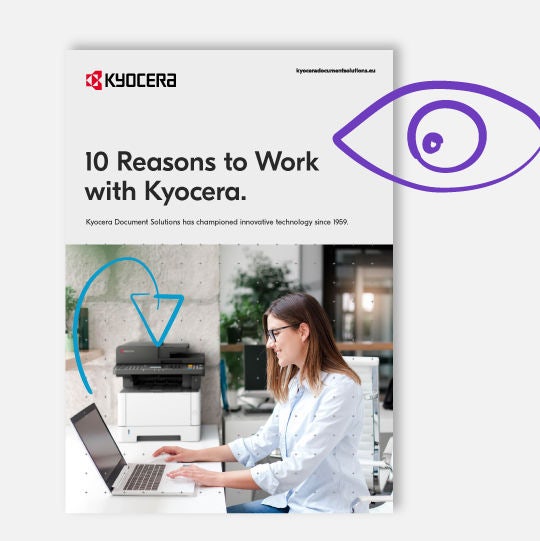
10 Reasons Why
From smarter document solutions and secure cloud technology to dependable hardware, explore the core advantages that make Kyocera a trusted partner for organisations shaping their digital future.
Devices and the cloud working together for ESG
Digital sustainability doesn't end in the cloud. It requires integrated, secure hardware that complements digital workflows.
MFPs remain essential in modern workplaces, especially for organisations transitioning toward paper-light environments. The goal is not to remove devices, but to ensure they are energy-efficient, secure and integrated with cloud document systems.
Kyocera’s TASKalfa MZ7001ci/MZ7001i Series supports secure cloud-connected workflows by enabling direct scanning to cloud platforms and controlled print release. Designed for cloud printing and secure data capture workflows, these devices empower organisations to streamline processes and improve print efficiency.
Sustainability is embedded at device level through:
- Energy-efficient operation.
- Reduced toner consumption.
- Long-life components that minimise replacement frequency.
By pairing secure devices with cloud technology, organisations build IT systems that support ESG goals without compromising performance.
Driving ESG progress through smarter IT
Sustainability reporting is no longer a peripheral activity. It is central to business resilience, investor confidence and regulatory compliance.
IT professionals are uniquely positioned to influence ESG outcomes. By modernising document solutions, consolidating infrastructure through cloud technology and embedding governance into IT systems, they can reduce environmental impact while strengthening operational efficiency.
Digital sustainability is not a standalone initiative. It is an outcome of deliberate digital transformation.


- Cut energy use with cloud printing and digital workflows
- Support digital transformation, reduce waste and boost efficiency
- Reap the benefits of a paperless office
Do you have any questions for our experts?
Whether you're exploring new hardware, upgrading existing systems or simply looking for guidance, our team is here to help.