
KYOCERA Document Solutions
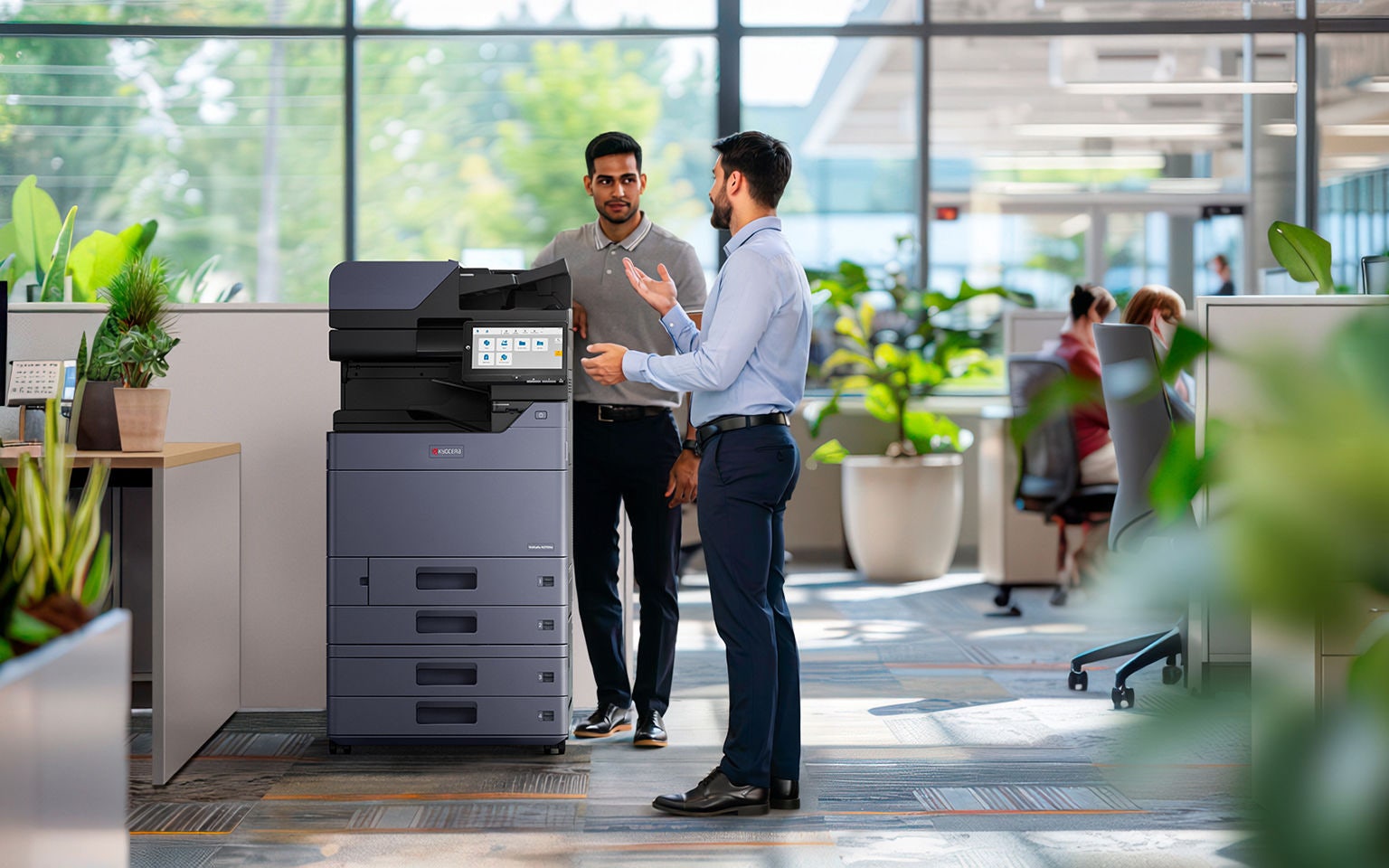


Kyocera Document Solutions helps organisations start with the foundational work of document capture and management, and build towards deeper transformation.
Artificial intelligence (AI) has become part of everyday work. According to a Gallup survey, the share of employees in the US who say they use AI in their job has nearly doubled over the two years to 2025(1). Firms are using AI-powered tools widely in content generation, workflow automation and document analysis.
However, the valuable output of AI models is optimised only if there is digitised, structured data available. Recognising this “data gap”, Kyocera Document Solutions is adapting its portfolio of products and services to the growing use of AI in knowledge work. “Companies that can effectively leverage AI gain advantages in productivity, decision-making and customer service,” explains Hiromasa Akamatsu, a deputy senior general manager in the company’s corporate global solutions division. “Therefore, organisations that are slow to respond increasingly risk losing competitiveness. Successfully harnessing AI requires an integrated approach: developing talent, redesigning business processes and strengthening governance.”
Consultants and advisers in technology and strategy agree and often stress workers’ need for new skills. The Boston Consulting Group, for example, suggests that “supporting practical application of AI tools in everyday work” and starting an “AI upskilling effort” is part of the playbook for increasing performance by implementing AI(2). For knowledge work, document management offers a gateway to begin that process by gently introducing AI into daily tasks.
Transformation begins with document capture
Crossing the boundary between physical and digital can be a perilous process for documents, beset with security risks and mistakes in digitisation. This is where Kyocera Document Solutions has thus chosen to focus its work when it comes to AI integration, particularly in the use of multifunction printers (MFPs) to scan paper documents into digital formats.
The company’s AI-enabled MFPs are what Kanako Kibihara, a senior manager in the company’s AI development department, calls “the first quality-control gate in paper document workflows.” During scanning, they can enhance image and text quality, inspect documents for defects, and detect stamps, watermarks and labels that identify them as confidential or access-restricted. “On-device AI features, which can be used directly on site, reduce dependence on specific individuals and help standardise operations,” she says. “A major strength is the ability to perform AI processing locally for sensitive documents that cannot be linked to the cloud, ensuring secure handling.”
Augmenting document capture with AI benefits firms of any size, and Kyocera makes it easier to begin the process by supporting its hardware with software solutions that address practical problems. An example of how this works can be seen at Mildura Base Public Hospital in Australia. There, administrators experienced difficulties including duplicated and missing invoices, and delays in securing management approval to pay when staff were off-site.
Following the implementation of Kyocera Enhanced Scan to Oracle (KESTO), the hospital staff report being able to get documents to the right teams faster, reducing the need for manual work in sorting, labelling and distributing documents, and speeding up payment approvals(3).
Activating the value of dormant data
After documents have been captured using AI-enabled MFPs, there is the next step of connecting, organising and utilising the data. “Our solutions turn data scattered across a customer’s various locations into usable information,” Mr Akamatsu explains. “They link, recognise, organise and apply it to improve operational productivity and contribute to the creation of new business value.”
Kyocera Cloud Capture is one of the processes. The cloud-based platform bridges physical and digital systems by helping to securely route documents scanned through MFPs to cloud-storage services. Kyocera Document Solutions highlights the potential of AI-driven approaches to support more efficient document capture and management.
“AI is most effective when it is applied to well-structured information,” Mr Akamatsu says. “By strengthening the foundations of document capture and management, organisations can create an environment where digital technologies are used more effectively in everyday work.”
AI is most effective when it is applied to well-structured information”
Hiromasa Akamatsu
Grounded in value activation
These capabilities reflect Kyocera’s brand principle, “Put knowledge to work.” Its MFPs and software solutions activate the value of dormant data through digitisation, amplifying the power of their judgement, creativity and relationships with colleagues and customers. And when AI is used to augment the devices that frontline staff use daily, workers can naturally advance digital transformation without needing to acquire extensive new skills.
In implementing its solutions, the company works with customers to identify their pain points, which it addresses first by quickly deploying MFPs and cloud-capture tools so as to lay the groundwork. It also focuses on building a strong foundation of document capture and information management, working with customers to address their immediate operational needs.
As use of AI in the workplace expands, the distinction between transformation and mere adoption becomes clearer. Tools alone are not enough to establish a competitive advantage. What matters is applying them in the right place, and in the right way, to increase efficiency, improve decision-making and delight customers.
This article was produced by EI Studios for Kyocera Document Solutions.
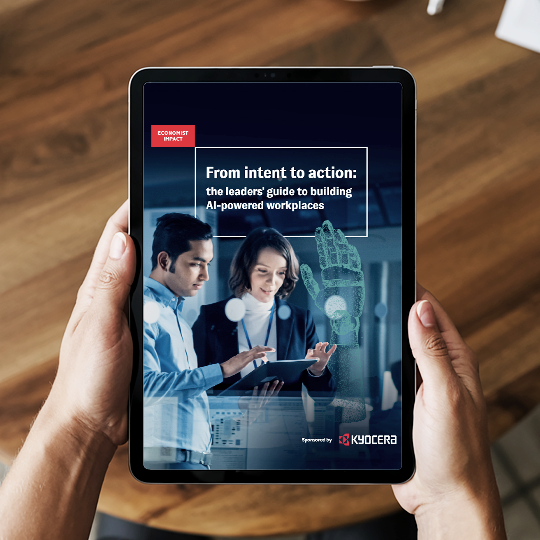
Download the report for free!
Learn how organizations can move beyond AI pilots, build internal capability, and prepare leaders and managers to support enterprise-wide deployment.
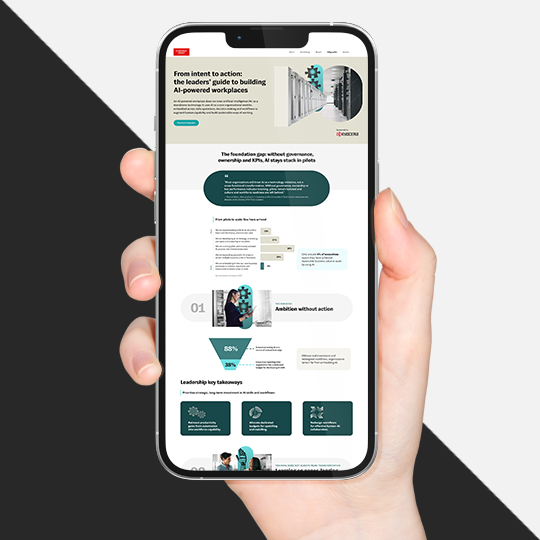
Explore the infographic
Download our infographic and explore the key findings on why AI remains stuck in pilots, where skills and governance gaps persist, and the leadership actions needed to scale AI across organizations.
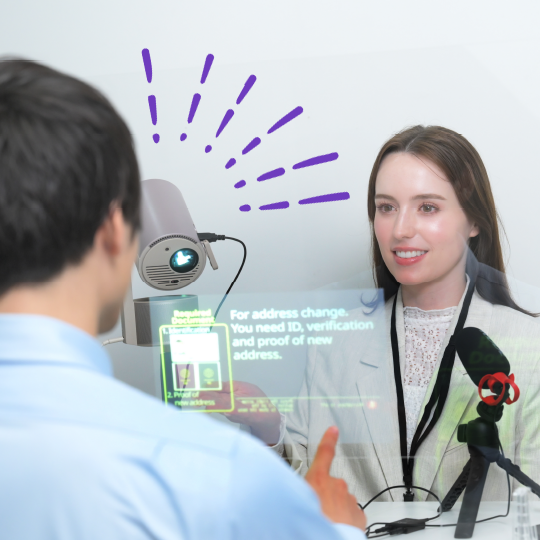
Communication without barriers: speech recognition for a symbiotic society.
A new solution from Kyocera Document Solutions is working towards a “symbiotic society” by bridging language barriers and hearing impairments to ease communication.
1 Ryan Pendell, “AI Use at Work has Nearly Doubled in Two Years”, Gallup, June 15th 2025, https://www.gallup.com/workplace/691643/work-nearly-doubled-two-years.aspx
2 Jessica Apotheker et al., “The Widening AI Value Gap: Built for the Future 2025”, September 30th 2025, https://www.bcg.com/publications/2025/are-you-generating-value-from-ai-the-widening-gap
3 Kyocera, “Creating Innovative Solutions for Smarter Healthcare”, accessed December 31st 2025, https://kyoceradocumentsolutions.com.au/creating-innovative-solutions-for-smarter-healthcare
Put knowledge to work
Kyocera helps organisations kickstart AI transformation with secure, AI-enabled
document capture and management, reducing manual work and turning
documents into usable information.