
KYOCERA Document Solutions
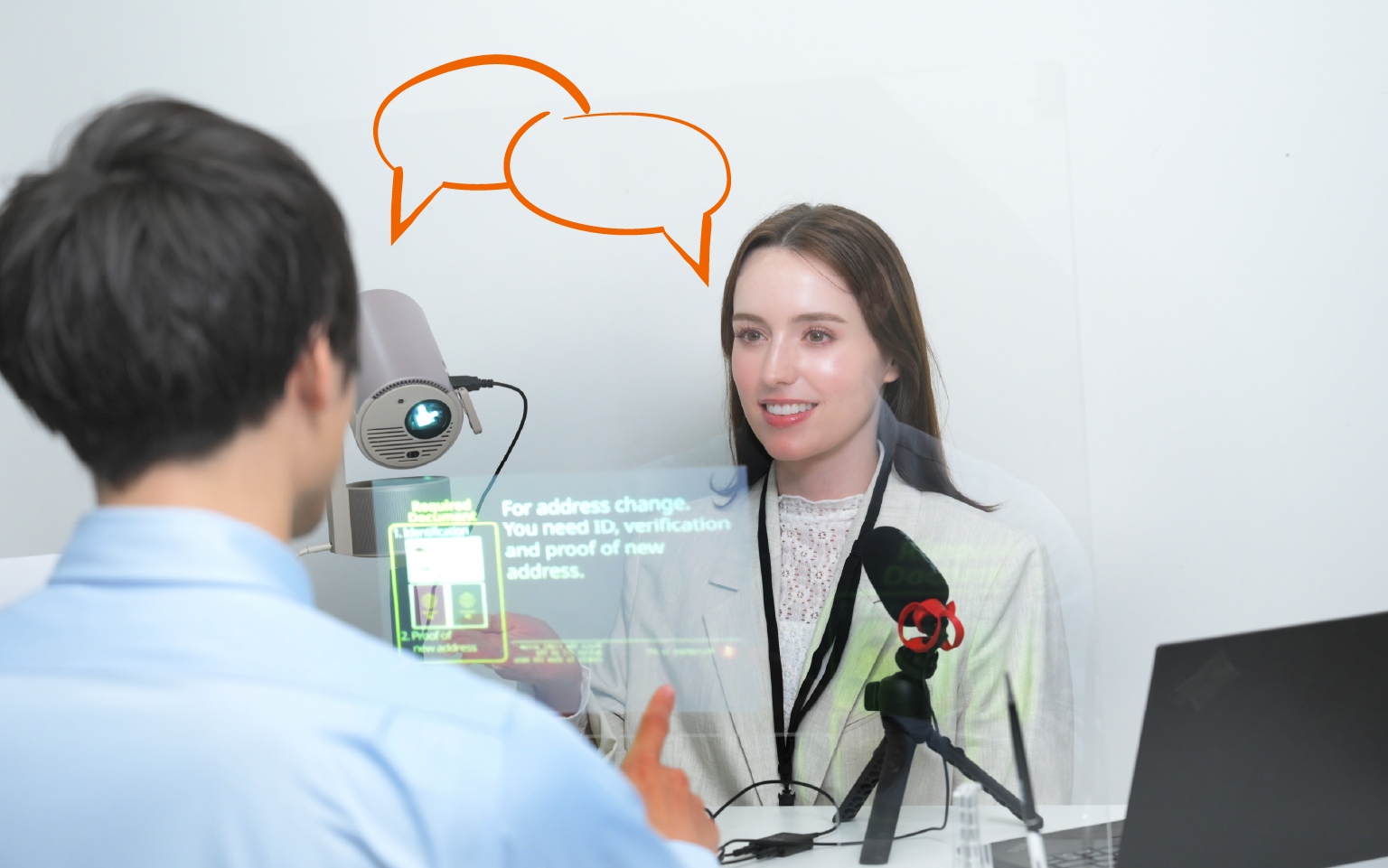


Communication is easy to take for granted until it breaks down. Migration, ageing and the lingering effects of the covid-19 crisis have exposed how fragile communication can be. A 2021 study from Washington University in St Louis found that face masks reduced speech intelligibility by around 30% in noisy places like coffee shops and offices(1).
Such experiences can deepen isolation for people who already find communication hard, including those with hearing impairments. The WHO estimates that a quarter of people over 60 have disabling hearing loss(2), and as populations age, that barrier highlights the importance of mutual understanding in daily life. Communication barriers also spring up as travel and migration make countries more linguistically diverse.
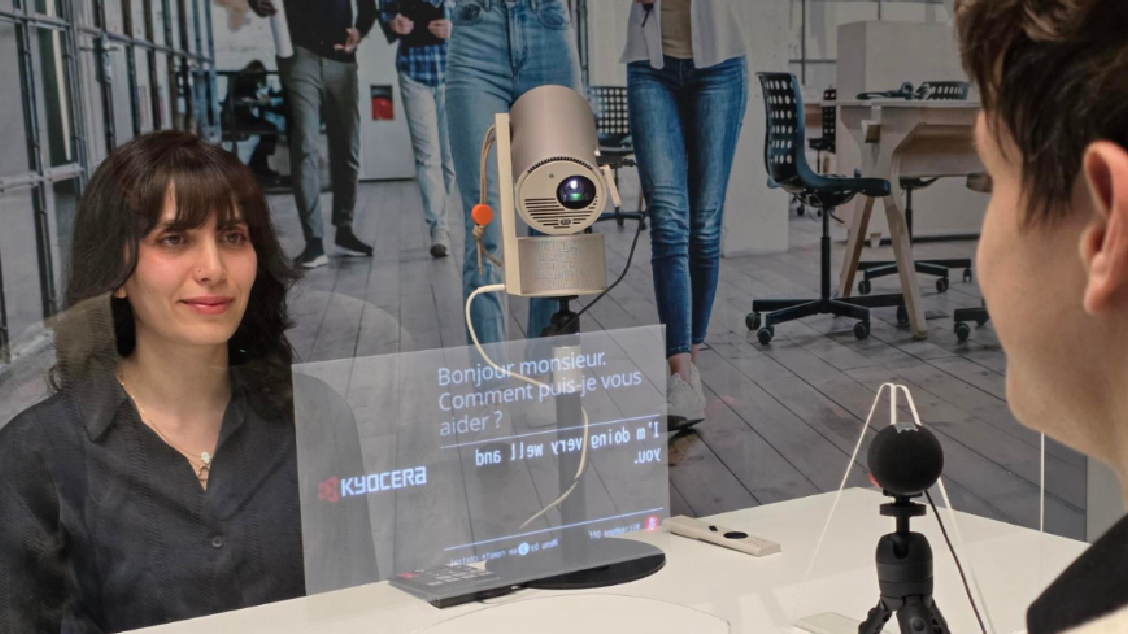
Kyocera Document Solutions has always been inspired by the potential of technology to enrich how people live together, and it believes artificial intelligence (AI) can be used to aid social participation. Since 2021 it has been developing Cotopat, a speech-recognition platform that converts spoken language into real-time subtitles on screens, with options to translate in real time(4). The display shows not only subtitles and translations, but also diagrams and videos based on the content.
Kyocera Document Solutions has always been inspired by the potential of technology to enrich how people live together, and it believes artificial intelligence (AI) can be used to aid social participation.”
Economist Impact
From comprehension to connection
Earlier communication solutions, such as written notes or interpreters, can be slow or leave people reliant on others. Keisuke Koyama, an executive officer and senior general manager of the corporate marketing division at Kyocera Document Solutions, says AI enables new solutions and “direct, rapid communication”.
Cotopat, for example, is robust enough even for complex contexts such as schools and workplaces, which “increases people’s autonomy and reduces barriers to social participation, contributing to the realisation of a symbiotic society where diverse people can thrive into reality,” says Mr Koyama.
AI enables new solutions and “direct, rapid communication.”
Keisuke Koyama, executive officer and senior general manager, corporate marketing division, Kyocera Document Solutions
In talking of symbiosis, he refers to the Japanese concept of kyosei, which can also be translated as “coexistence”—a core part of the Kyocera Group’s management philosophy(5). “Harmonious coexistence is the underlying foundation of all our business activities as we work to create a world of prosperity and peace,” says one official statement of the company’s values. The word also applies to contemporary notions of social diversity, recognising mutual acceptance between people who differ along lines including gender, ethnicity and ability(6).
Cotopat, in action
Education is an important field where Cotopat is having a positive social impact. At Doshisha University in Kyoto, the student support division uses it as a real-time subtitling solution that projects the words on an acrylic screen, letting students with hearing impairments easily follow conversations while keeping their eyes on the speaker. Meanwhile, international students can use translation features to overcome language barriers. In both cases, the technology supports independent participation in academic life.
Cotopat also helps the university comply with Japan’s Act for the Elimination of Discrimination against Persons with Disabilities(7), which requires organisations to take measures to remove barriers to participation. Beyond compliance, the system is broadening access to education and future employment for students who might otherwise be disadvantaged by communication difficulties. In time, this will boost diversity in Japanese workplaces.

Cotopat can also be seen in action at Kyocera’s Customer Experience Studio in Milan. The platform is available there as a tool to aid communication with visitors from the region, overcoming language barriers and hearing difficulties where they exist.
“Europe is characterised by linguistic and cultural diversity,” says Toshikazu Kawauchi, a manager in Kyocera Document Solutions’ global solutions planning division. “In addition, accessibility-related regulations have been enacted, placing strong practical demands on public administrations and businesses.” The European Union (EU) Charter of Fundamental Rights requires that EU institutions be able to communicate with the union’s nationals in any of the 24 official languages(8).
But millions of migrants across Europe speak other languages, ranging from Turkish to Berber and Punjabi(9). he continent is also experiencing population ageing, which adds to existing communication challenges. “For these reasons, communication support that can be used immediately on-site and is easy for anyone to use is particularly necessary,” says Mr Toshikazu.
Europe is characterised by linguistic and cultural diversity … For these reasons, communication support that can be used immediately on-site and is easy for anyone to use is particularly necessary.”
Toshikazu Kawauchi, manager, global solutions planning division, Kyocera Document Solutions
The firm’s speech-recognition solution is marked by an emphasis on visual communication, business applicability, accuracy and accessibility(10). By enabling users to maintain eye contact and see facial expressions during conversation, it aims to help people read situations and emotions and respond naturally, enabling kuuki o yomu, the Japanese concept that translates into “reading air”, and refers to the essential ability to understand subtle, often unspoken social cues to act appropriately and considerately in everyday situations.

Looking ahead, further advancements in AI could make sign language and gesture recognition practical in this field, bringing spoken, signed and written communication together.
Towards a symbiotic society, for the world around us
Through its innovations, Kyocera Document Solutions strives to minimise environmental burden, aid social participation, and to promote a more inclusive, sustainable society through AI-enabled services and products.”
Economist Impact
Helping people read the room advances the realisation of a symbiotic society and puts Kyocera’s broader ethos into motion.
Kyocera Document Solutions’ new sustainability message, “For the world around us”, builds on this spirit, reflecting a moral commitment to recognise and harness the bond between human minds by acting unselfishly; Cotopat is testament of the slogan in action. Through its innovations, Kyocera Document Solutions strives to minimise environmental burden, aid social participation, and to promote a more inclusive, sustainable society through AI-enabled services and products.
This article was produced by EI Studios for Kyocera Document Solutions.
Download the report for free!
Learn how organizations can move beyond AI pilots, build internal capability, and prepare leaders and managers to support enterprise-wide deployment.
Explore the infographic
Download our infographic and explore the key findings on why AI remains stuck in pilots, where skills and governance gaps persist, and the leadership actions needed to scale AI across organizations.

Document management: the missing link in AI adoption
The increasing adoption of AI-powered tools in workplaces raises questions about where they can be implemented first to solve pain points and make quick productivity gains.
1 Violet A. Brown, Kristin J. Van Engen and Jonathan E. Peelle, “Face Mask Type Affects Audiovisual Speech Intelligibility and Subjective Listening Effort in Young and Older Adults,” Cognitive Research: Principles and Implications, vol. 6 (2021), https://link.springer.com/article/10.1186/s41235-021-00314-0
2 World Health Organisation, “Deafness and Hearing Loss”, February 26th 2025.
3 Kyocera Document Solutions, “Kyocera Develops the Subtitle Display System ‘Cotopat Series’ and Starts Sales in Japan”, December 12th 2023, https://www.kyoceradocumentsolutions.com/en/news/rls_2023/rls_20231212.html
4 Kyocera Document Solutions, Cotopat, https://www.kyoceradocumentsolutions.com/global/en/our-business/cotopat.html
5 Kyocera, “Corporate Motto”, accessed November 26th 2025, https://global.kyocera.com/company/philosophy.html. Observations about the translation of kyosei (normally kyōsei, but The Economist does not use macrons for long vowels)are based on a comparison with https://www.kyocera.co.jp/company/philosophy.html
6 Osaka University School of Human Sciences, “Kyosei Studies (Critical Studies in Coexistence, Symbiosis and Conviviality)”, accessed January 15th 2026, https://www.hus.osaka-u.ac.jp/en/undergraduate/sym/
7 Based on machine translation of Doshisha University, “We Have Introduced a Subtitle Display System to the SDA Room!”, December 7th 2023, https://www.doshisha.ac.jp/news/detail/001-NHvznC.html ; see also “Support for Challenged Students”, https://www.doshisha.ac.jp/en/student_life/challenged/index.html. Act name confirmed at https://www.japaneselawtranslation.go.jp/en/laws/view/3052/en
8 European Union, “Languages”, accessed November 26th 2025, https://european-union.europa.eu/principles-countries-history/languages_en
9 European Day of Languages, “Language Facts”, accessed November 26th 2025, https://edl.ecml.at/Facts/Language-Facts
10 Paraphrase of quote from Mr Kawauchi.
Put knowledge to work
Kyocera helps organisations kickstart AI transformation with secure, AI-enabled
document capture and management, reducing manual work and turning
documents into usable information.