
KYOCERA Document Solutions


Digital transformation has fundamentally changed how organisations store and share information. Businesses now rely heavily on cloud platforms and digital document management solutions to support modern workflows.
At the same time, hybrid and remote work models have increased the number of devices connected to business networks, including office printers and multifunctional printers (MFPs).
Each connected device can become a potential entry point for cyber threats. Without secure printing solutions in place, confidential information may be exposed through unauthorised access, unattended documents or network vulnerabilities.
For organisations handling sensitive data, secure printing is now an essential part of any cybersecurity and data protection strategy. In this blog, we explore the key principles businesses should consider when implementing secure printing solutions.
Why secure printing matters in the modern workplace
The shift toward digital workflows and hybrid work has expanded the number of locations where employees access and share documents.
Instead of operating within a single office environment, staff may now print or scan documents from multiple devices and networks. Home Wi-Fi networks, mobile devices and shared digital platforms all introduce additional security risks.
At the same time, the volume of documents being digitally shared continues to grow rapidly. This carries not only operational risks but also regulatory implications.
Under the General Data Protection Regulation (GDPR), organisations that fail to protect personal data can face substantial financial penalties. For example, fines can reach €20 million or 4% of a company's annual global turnover.
Enforcement activity has also increased substantially in recent years. Legal analysis shows that around €1.2 billion in GDPR fines were issued across Europe in 2024 alone.
These figures highlight why businesses must treat secure printers and document workflows as critical components of their overall data protection strategy.
CIA: the three pillars of secure printing
When evaluating secure printing solutions, Kyocera identifies three key principles that underpin effective document security: Confidentiality, Integrity and Availability (CIA).
These pillars ensure that information remains protected throughout the entire document lifecycle, from creation and transmission to secure document storage and retrieval.
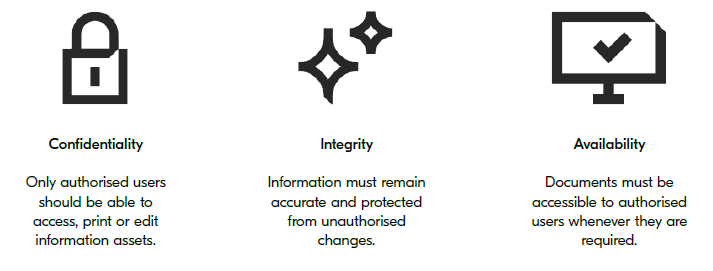
Confidentiality, integrity and availability in practice
These three principles apply directly to printing environments, where documents are created, shared and stored across multiple devices. Secure printing solutions help protect sensitive information, prevent unauthorised changes and ensure documents remain accessible when needed.
Kyocera designs MFPs and office printers with the CIA framework in mind to protect business data from information leaks, data alteration and cyber threats.
Kyocera designs MFPs and office printers with the CIA framework in mind to protect business data from information leaks, data alteration and cyber threats."
How Kyocera supports secure printing
Beyond CIA, Kyocera supports secure document workflows with cloud-based document management solutions designed to protect sensitive information.
Document management solutions
Kyocera Cloud Information Manager (KCIM) enables organisations to manage large volumes of documents through secure document storage in the cloud. Digital files are stored in a protected repository with strict access permissions, allowing businesses to maintain strong control over confidential information regardless of where employees are working.
To further enhance security, access rights can be configured by document category and user role, with detailed audit trails providing visibility into how documents are accessed and used.
Kyocera Cloud Capture (KCC) strengthens data protection by securely digitising paper documents through MFPs and sending the captured information directly to a designated cloud destination. Secure login methods such as ID card authentication and PIN codes ensure that only authorised users can capture and process documents.
By removing the need to upload scanned files to a PC first, KCC helps reduce risks such as document loss, tampering or PC-based data breaches, while making it easier for remote teams to capture and access information securely.
Office printers and MFPs
Secure printing environments depend not only on software but also on robust hardware protection. Kyocera’s ECOSYS and TASKalfa series combine reliable printing performance with advanced security features designed to protect sensitive data.

Secure Boot & RTIC
Secure Boot and Run-Time Integrity Check verify firmware during startup and operation. If irregularities are detected, the device shuts down to prevent malicious activity.
Firmware update protection
Administrator authentication ensures that only authorised personnel can approve firmware updates, preventing malicious code from being installed.
Trusted Platform Module (TPM)
TPM securely stores cryptographic keys inside the device, protecting sensitive information even if a printer’s storage drive is removed.
Encrypted communication
Protocols such as TLS 1.3 and S/MIME encrypt data during transmission, protecting documents and emails from interception across networks.
Together with monitoring tools and configurable access controls, these capabilities help organisations build secure printing environments that protect information while maintaining reliable document workflows.

Security you can trust
Cyber threats increasingly target connected devices, including printers. Kyocera’s ECOSYS and TASKalfa series provide end-to-end protection with features such as secure boot, firmware integrity checks, encryption and Trusted Platform Module technology. Discover how these advanced security capabilities help businesses safeguard documents, protect networks and maintain secure printing environments.
Powering secure printing for the modern workplace
As organisations continue to embrace digital transformation and hybrid working, secure document workflows have become increasingly important.
Office printers and MFPs must now be treated as critical endpoints within an organisation’s cybersecurity strategy.
By focusing on the three CIA pillars of secure printing – Confidentiality, Integrity and Availability – businesses can protect sensitive information while maintaining efficient document workflows.
Kyocera helps organisations apply these principles in practice by delivering secure printing solutions designed for modern digital workplaces.

- Simple cybersecurity habits every business should follow
- Protecting business data in the new age of working
- Steps to strengthen document security through digitalisation
We're here to help!
Our team of experts is here to answer your questions, solve your challenges and deal with your sales inquiries.